
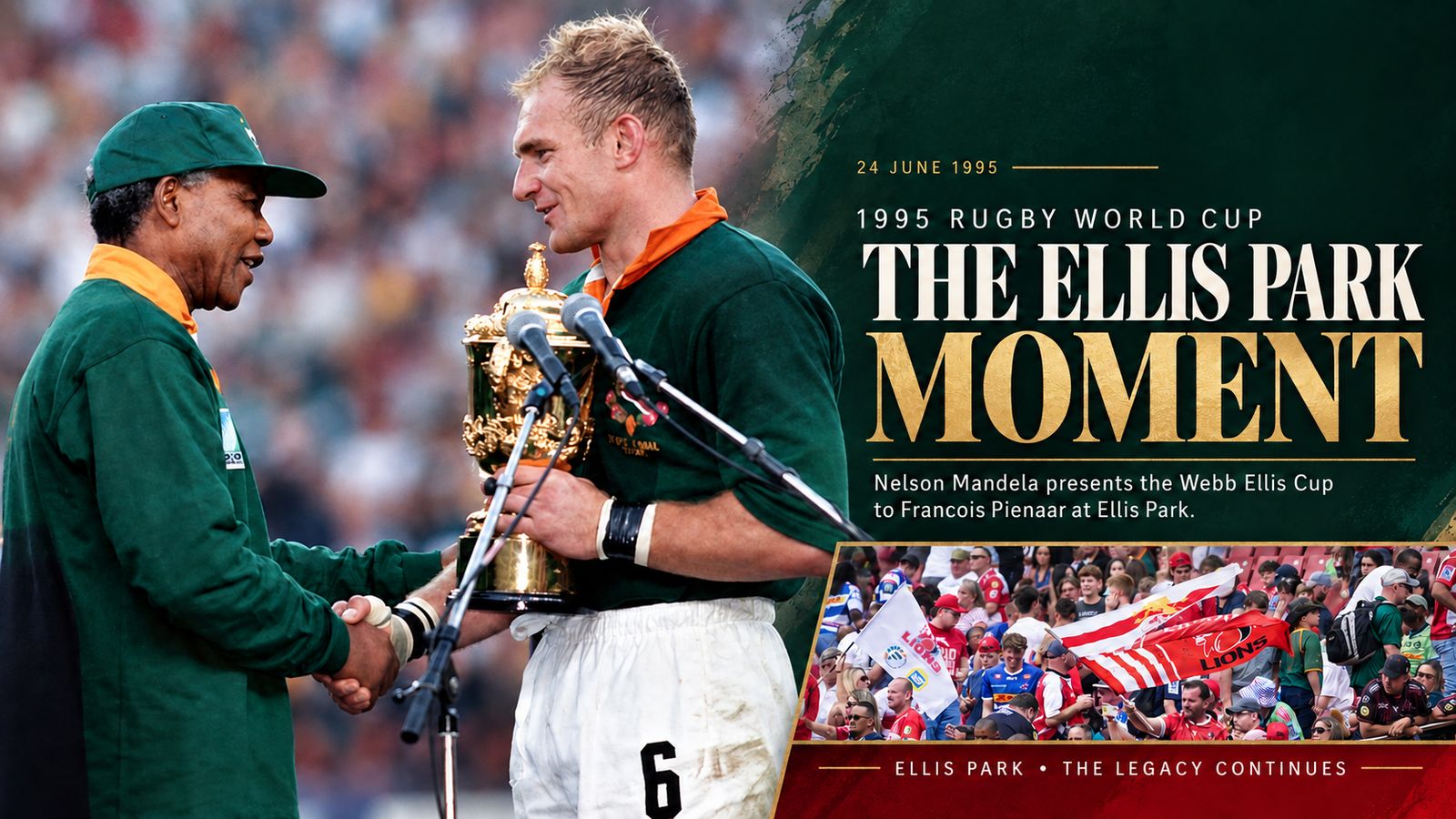
24 June 1995
There is no other rugby ground on earth that can claim what happened in Doornfontein that afternoon. This is the most important page in this book.
Every stadium has a best day. Ellis Park has a day that stopped being about sport before the final whistle had gone.
THE ROAD TO IT. South Africa had not been at a Rugby World Cup before. Isolation had kept the Springboks out of 1987 and 1991, and when the country was awarded the 1995 tournament it arrived as host and debutant at once — a side nobody could rank because nobody had seen enough of it. They opened against Australia, the holders, at Newlands and won. They beat Western Samoa in a quarter-final at Ellis Park, and then France in Durban in a semi-final played in standing water, on a pitch that a few centimetres more rain would have rendered unplayable.
The final was set for 24 June, at Ellis Park, against New Zealand — a side that had just put 45 points on England in a semi-final and had Jonah Lomu in the eleven jersey.
THE MATCH. It was a poor spectacle by the standards of modern rugby and nobody who was there cares. No tries were scored. Joel Stransky and Andrew Mehrtens exchanged penalties and drop goals in front of 62,000 people who could barely breathe. Lomu, who had run through England four days of newsprint earlier, was hunted down all afternoon by a defensive plan that gave him nothing. Twelve-all after eighty minutes.
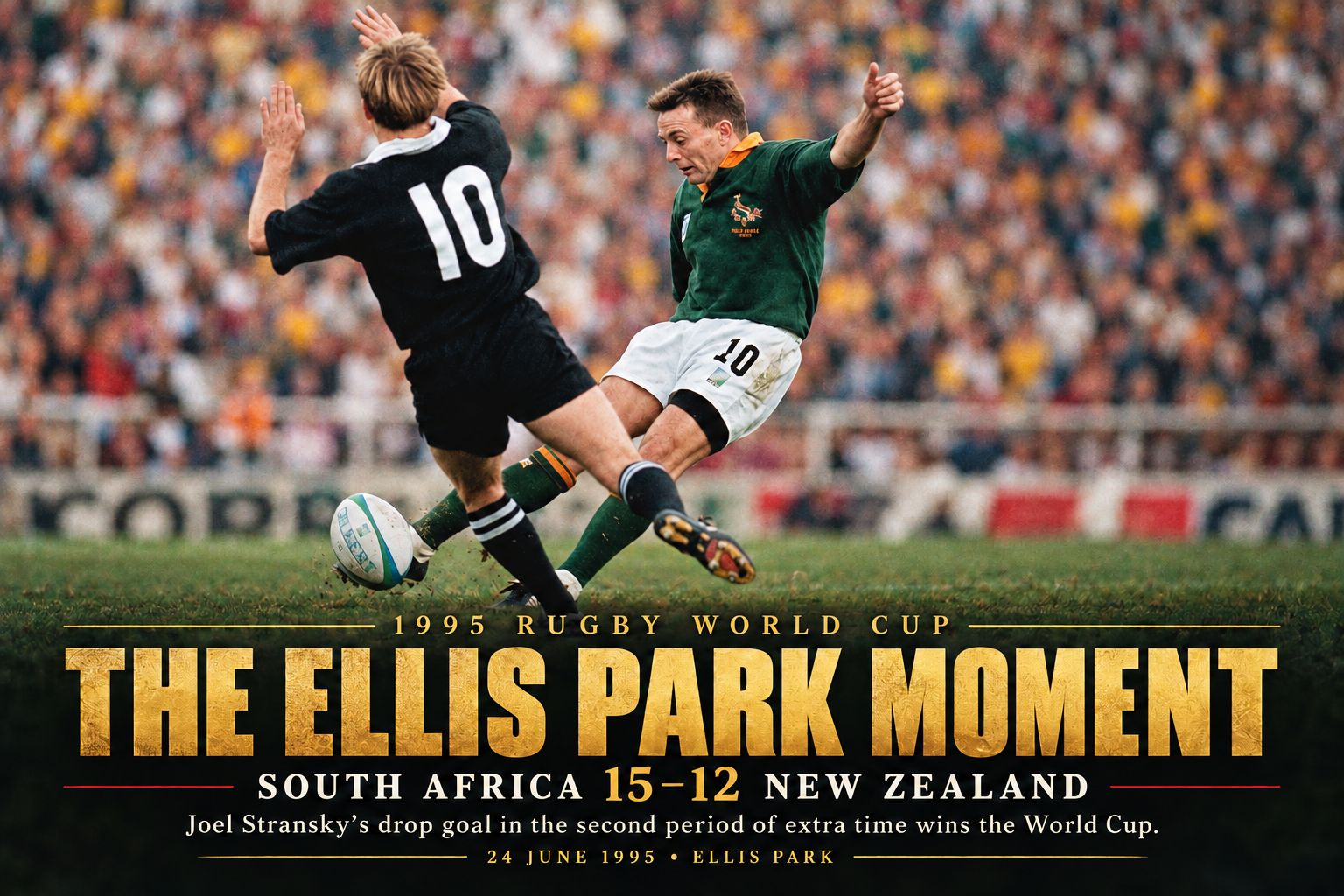
Extra time. Mehrtens missed a drop goal that would have won it. And then, in the second period, Stransky dropped a goal from in front of the posts and South Africa won 15-12.
THE THING THAT HAPPENED NEXT. Nelson Mandela walked onto the field at Ellis Park wearing a Springbok jersey with Francois Pienaar's number six on the back.
Five years earlier he had been in prison. The jersey he was wearing had been, for most of his life and for most of the people watching, the single most concentrated symbol of the system that put him there. The Springbok emblem had been debated inside his own party as something to be abolished. He wore it anyway, in front of a crowd that had spent decades on the other side of that line, and handed the trophy to a Johannesburg flanker who had captained Transvaal on the same pitch eighteen months before.
"Thank you for what you have done for our country," the President said. Pienaar's reply has been quoted ever since: sixty-three thousand South Africans in the stadium, and forty-three million in the country.
THE PHOTOGRAPH. The image of that handshake is one of the most reproduced in the history of sport. It has been on stamps, on murals, and on the walls of schools on every continent. It was the closing scene of a Clint Eastwood film in 2009. It is shown in classrooms by people who could not name a single other rugby player, and it is used, correctly, as shorthand for a moment when a country chose to be something it had not been before.
THE JOHANNESBURG CLAIM. It is worth stating plainly, because it gets lost in the national retelling.
That afternoon happened here. In Doornfontein. On this pitch, in this stadium, in front of this city. And the man holding the trophy was a Transvaal captain who had lifted the Currie Cup on the same grass two seasons earlier, in a side coached by Harry Viljoen that had won the inaugural Super 10 at this ground against an Auckland team full of All Blacks.
Ellis Park did not host the moment by accident of scheduling. It hosted it because it was the largest rugby ground in the country, in the largest city in the country, in a tournament the country was staging for the first time. Johannesburg earned the fixture, and then the fixture became history.
WHAT IT CHANGED. The romantic reading is that 1995 healed a nation in eighty minutes, and it did not — the thirty-one years since have been considerably more complicated than that. What it did do is establish that the Springboks could be a side the whole country claimed, and that changed the pool of players, supporters and expectation every subsequent squad has drawn from. Four World Cup finals, four wins, and a black captain lifting the trophy in Yokohama in 2019. All of it traces back to this ground.
THE THING TO UNDERSTAND. Rugby produces great matches constantly and forgets most of them inside a decade. What happened on 24 June 1995 was not a great match. It was a country deciding, for eighty-plus minutes and then for one photograph, to be something new — and it chose this ground to do it in.
Every side that runs out at 10bet Ellis Park runs out on that pitch. Every supporter who walks through the turnstiles walks into that building. When Stade Toulousain arrive in December for a Champions Cup pool match, they will be playing on the field where Joel Stransky dropped that goal.
Most grounds sell history. This one has a claim no amount of money could manufacture.
Thirty-one years on, it remains the most important eighty minutes ever played in Doornfontein, and it is very hard to imagine anything ever taking its place.
Every stadium has a best day. Ellis Park has a day that stopped being about sport before the final whistle had gone.
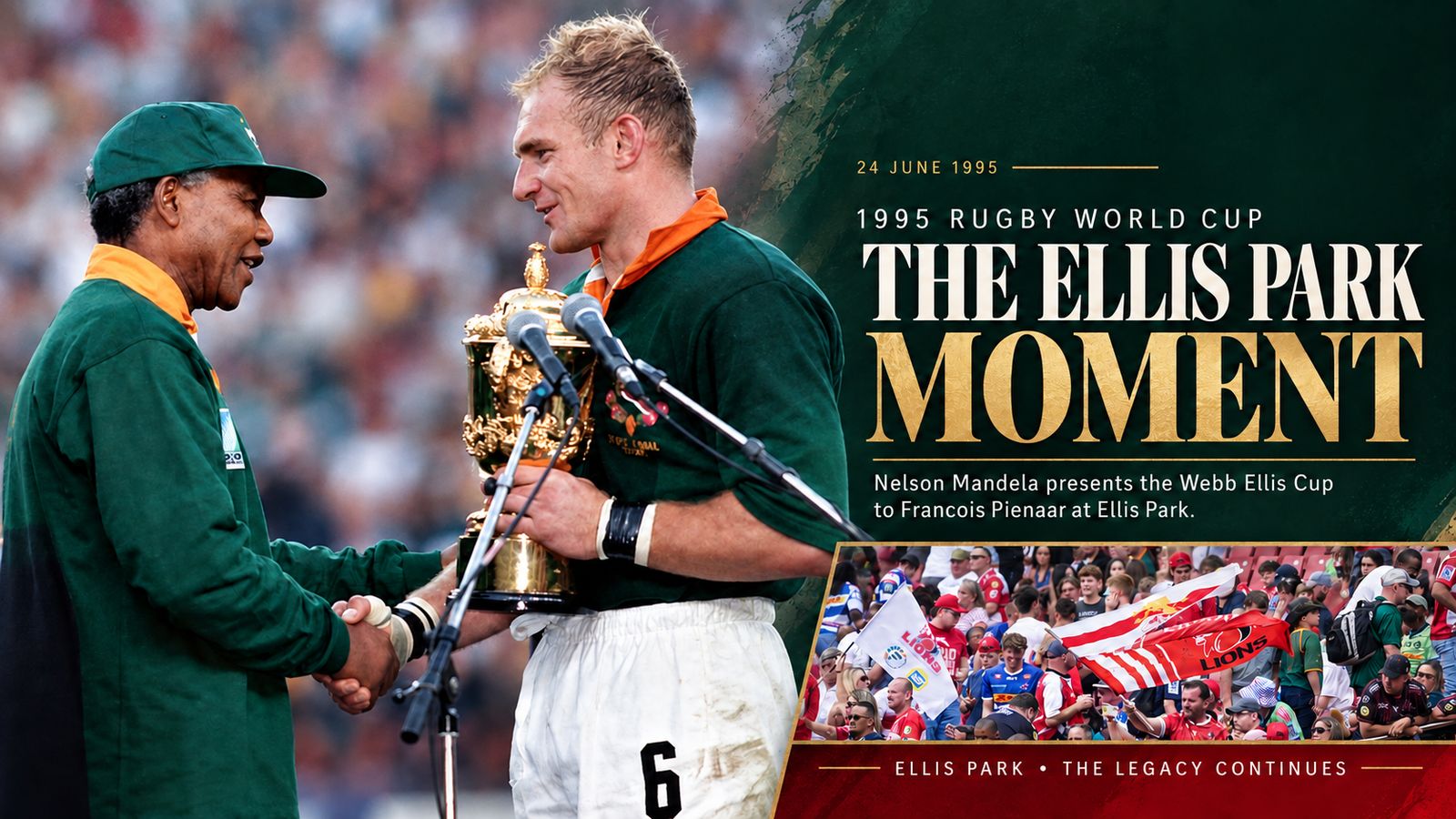
- 0124 June 1995: Nelson Mandela presents the Webb Ellis Cup to Francois Pienaar at Ellis Park.
- 02Joel Stransky's drop goal in the second period of extra time wins the World Cup, 15-12.
- 0362,000 at Ellis Park for the 1995 Rugby World Cup final.